Showing posts with label teaching. Show all posts

April 21, 2020

Original poem: Ode to Langston Hughes


Harlem - By Langston Hughes
What happens to a dream deferred?
      Does it dry up
      like a raisin in the sun?
      Or fester like a sore—
      And then run?
      Does it stink like rotten meat?
      Or crust and sugar over—
      like a syrupy sweet?

      Maybe it just sags
      like a heavy load.

      Or does it explode?


My poem:
Ode to Langston Hughes’ “Harlem”
I have a dream
I’m sorry, chemo brain gave me the wrong black history guy
I want to scream

The weight of his words
Falling from the sky
Flittering like birds

Ideas stuck inside of me
My brain is running dry
Can cancer make you not love me?

We carry this shared weight
You and me, and we, and I
Hope seems like cruel bait

The future is a trap
Time just keeps going by
There’s only so much around which my mind can wrap

Langston Hughes infects my memories
Of literature classes gone by
Will my students remember me?

Langston Hughes knew what to do with the words
With the right words, we can fly
I have a dream of being a bird
-         25 March 2020

March 11, 2020

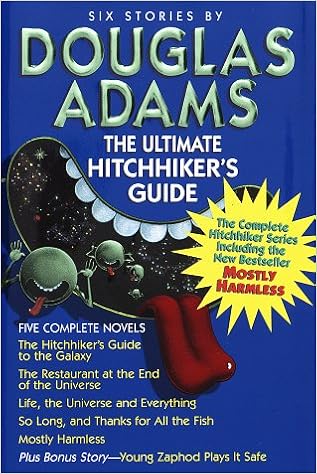
Happy Birthday, Mr. Adams!

Today is Douglas Adams' birthday!


You may or may not remember, but The Hitchhiker's Guide to the Galaxy is my favorite book.

When I am feeling sad, or unsettled, lost, or just not right, I can pick up this book and open it to literally any page and start reading. It doesn't matter where I end up, it's always a good part of the story.

I am very pleased to say that recently, The Husband started reading this book. Now, bear in mind, this book, which is very important to me, is almost 800 pages long. I know that The Husband must like me at least a little, because it is quite a commitment to read someone else's favorite 800-page book. Meanwhile, every few nights, I glance over at his kindle and read over his shoulder for a few minutes. I can't say if he will love this book as much as I do, but I can say that it makes me feel even more loved that he is reading this special story for me. The occasional snicker I hear while he is reading fills my heart with even more love for this book AND this man.

I've had some people posit to me that this book is not actually very well-written. I ignore those people. Yes, I do teach Composition and occasionally Literature at the community college, but that doesn't mean that I am restricted to only reading capital-L Literature. I don't care if this book is not Literature. This story fills my heart, and any opportunity I have to share it brings more love and laughter to my life.


Dearest Husband of mine, I only hope that as you continue working your way through this monster of a book, that you continue having fun with it. That's really the point, right?


So, that's it. I bow my heavily-scarred head to you, Mr. Adams, and thank you for all of the joy, past, present, and future, your story has brought to my life. Happy birthday!

February 10, 2020

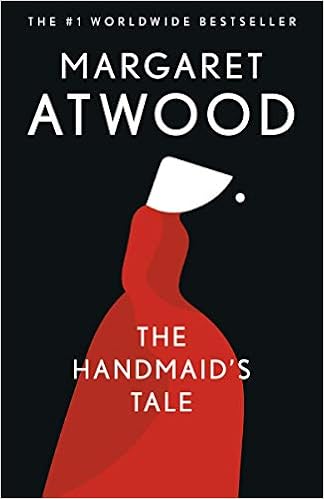
Fave Quote of the Book: The Handmaid's Tale by Margaret Atwood

The Handmaid's Tale by Margaret Atwood

Amazon link:
In Margaret Atwood’s dystopian future, environmental disasters and declining birthrates have led to a Second American Civil War. The result is the rise of the Republic of Gilead, a totalitarian regime that enforces rigid social roles and enslaves the few remaining fertile women. Offred is one of these, a Handmaid bound to produce children for one of Gilead’s commanders. Deprived of her husband, her child, her freedom, and even her own name, Offred clings to her memories and her will to survive. At once a scathing satire, an ominous warning, and a tour de force of narrative suspense, The Handmaid’s Tale is a modern classic.

I've taught this novel in the classroom. The experience of teaching this novel was made even more interesting because this book is easily in my top 10 favorite books of all time. Point of interest: I collect signed books. I've always wanted a signed copy of this book, and interestingly, when I mentioned this in class in the fall of 2017, I failed to be entirely clear with my intent. At the end of that semester, I received a gift from three students: a signed copy of the book.

Let me clarify. This book is not signed by Margaret Atwood. Instead, it was signed by those three students.
"Mrs. Blank,
Coming into college, the impression we all were under was that all college professors sucked and we would be miserable, especially in English. Over the past semester, you have not only been one of the coolest teachers we've had in high school and in college, but you've been one of the best. You've taught us so much but at the same time, we've had a lot of fun. I know myself, Student B, and Student C have been a handful and we appreciate you dealing with all our crap. You said you wanted a signed copy of this book so we went out and got you one. See you around campus, Student A, Student B, and Student C"
The class these boys were in was one that affected me deeply. It was my third year teaching, and this was one of the first classes in my short experience where I discovered that the dynamics of a classroom can make it feel like only a classroom, or the dynamics can make it feel like a real community. This was a class of very smart students with very bright futures, and we laughed, but we also had some very serious conversations. I won't say that this specific group of students was my favorite class I've ever taught, but they sure came close. It was because of these students that I realized that teaching did not have to be painful. I learned as much from those students as I hope they learned from me.

Without further ado, my favorite quote from this book, when the protagonist is speaking privately and illicitly with her Commander in his office: He tells her that the Republic of Gilead is better than what they lived with before. "Better?" The protagonist asks. "How can he think this is better?":
"Better never means better for everyone, he says. It always means worse, for some" (Atwood 211).

This is something that I hadn't thought much about, in general, or specific to this story; nonetheless, when I first read this, I underlined it as something to contemplate. Is this always true? It feels like it is a universal truth, but I am not sure. Is this what life is about: a zero-sum game where some win and some lose?

Those special students of mine expected to be miserable in my class. (Why do so many people hate English class?).

I was able to show them that my class could be better than what they expected, but I am sure, over the years, that there have been enough students whom I was unable to reach.

Even in a book that I have read easily a dozen times, I am still able to share those glimpses of magic, those moments when the world between the pages grabs at you and refuses to let go.

January 24, 2020

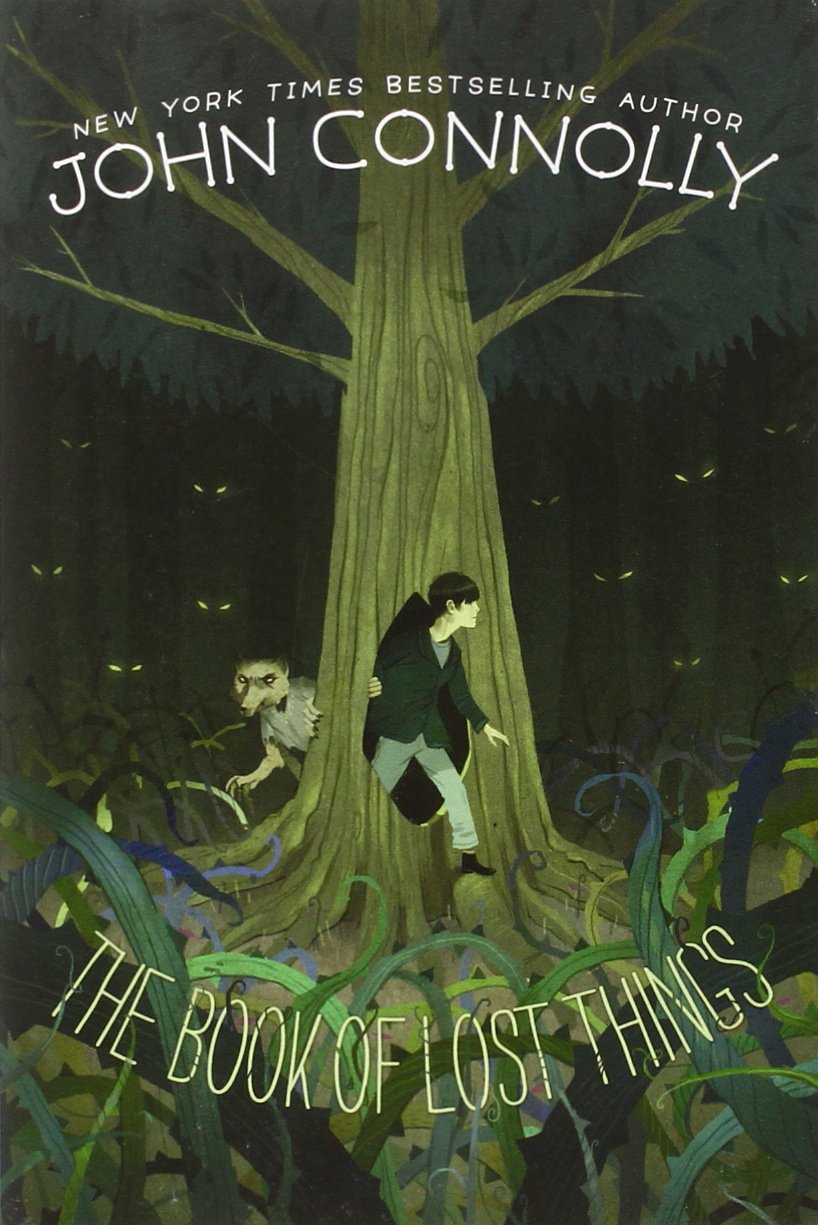
Books: The Book of Lost Things by John Connolly (Fin)

I am finally and unfortunately finished with this story. This is the kind of story that I wish I could start again and read it for the first time again. Immediately upon finishing this story, I realized that I would need to rearrange my top 10 favorite books, because this Book of Lost Things was firmly in the top 5. At the ending of this beautiful book, David returns to the land that is not quite like our own to find that it continues to reveal surprises.


"[A] woman appeared. She had dark hair and green eyes. In her arms she held a baby boy, barely out of the womb, who clutched at her blouse as she walked, for a lifetime was but a moment in that place, and each man dreams his own heaven. And in the darkness David closed his eyes, as all that was lost was found again" (Connolly 338-9).
Damn you, John Connolly, for writing a book that brought actual tears to my eyes! It has been quite a long time since a book has made me cry, and every time I re-read these last few sentences, I feel that tingle, as if I were cutting onions.

I don't know if everyone fears death, but I do know that there are only two innate fears that every human is born with: falling, and loud noises (the "acoustic startle reflex"). Do I fear death?

Sometimes.

Sometimes it terrifies the hell out of me. One thing that I struggle with is the unknown (as I am sure is common for many of us). Death being the ultimate unknown is terrifying. But occasionally, every once in a long while, I will find a moment of peace. Was I afraid of being born? What, fundamentally, is the difference?

Unanswerable questions.

Back to The Book of Lost Things: a death like David's seems almost unfair. No pain. No trauma. Just the final literal steps in a journey, only to be greeted by those whom he had loved and lost and found again.

If death is like this, there is nothing to fear. There is nothing but joy and love at the end of the journey. We could spend a lifetime regretting the things we may or may not have done, but regret is meaningless in the end. Regardless of what you do or do not believe in, and regardless of your faith or lack thereof, save the regrets. Instead, spread joy and love where you can.

So.

Instead of regrets, I will try to cherish my memories and my mistakes. Those mistakes have made me who I am today. In the end, I can only hope that sharing joy and love will balance out any mistakes I have made.

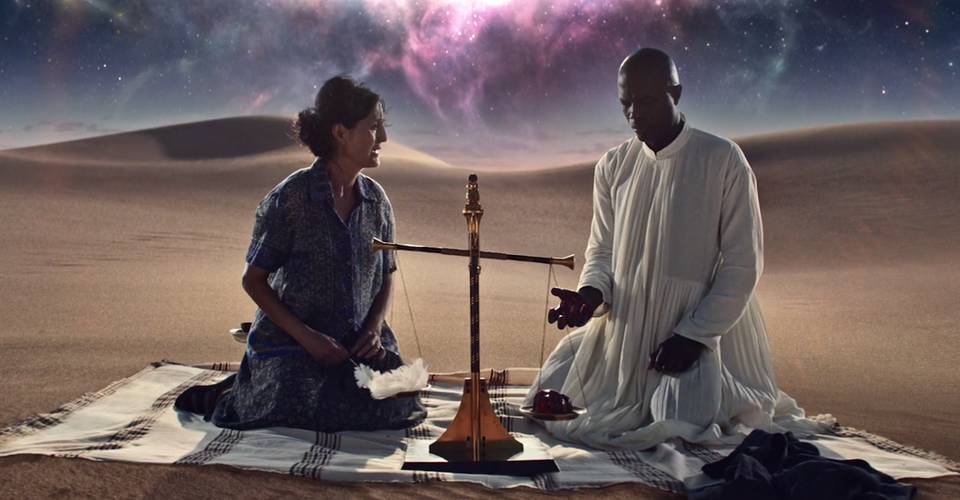
Anubis casting judgment in S1 Ep3 of American Gods

January 20, 2020

Books: The Power of Myth by Joseph Campbell with Bill Moyers (Part 5)

I am almost finished with The Power of Myth by Campbell and Moyers.

Before I get to that, remember that last time, I talked about learning from our imperfections, and I examined the cycle of death and life and death again. I looked at the beauty and ugliness in the world, and in myself, and I pondered the meaning of life.

I feel like some may think that my cancer has made me morbid and self-involved with this little blog of mine.

Some may think that I am being obsessive to spend so much time thinking about death. That I'm giving up hope and letting the cancer take over. That I don't believe in the possibility of a miracle for my incurable cancer.

The thing is, for so many people, the D-word is a word used only in whispered conversations, laced with euphemisms. Passed away. Lost the battle. In a better place.

I am not obsessed with death.

For the first time, I am forcing myself to contemplate the ultimate and universal reality.

To pretend that any of us will escape death is to indulge in a childish fantasy. I am not giving up, and I am not going down without a fight.

So think of how you prepare for a battle. You would never go into battle without checking your kevlar vest and making sure you have extra ammo, right? You would be sure that the tools you need for battle are all functioning, right? You would study the maps and memorize the evacuation routes, right?

What I am learning is that no matter how much I prepare by reading books by Buddhist nuns, battle-hardened admirals, historians, philosophers, and other academics, ultimately, death is not the enemy.

Yes, life is too short, but that doesn't mean that death is to be hated, feared, demonized. It is simply part of the journey that we all travel. For some of us, the journey may be uneventful and even banal, and for some, the journey might be a terrible adventure that constantly tests our will, our strength, our souls.

In Robert Frost's poem "The Road Not Taken," a poem I have taught many times in many classrooms, I have had to disabuse my students of the idea that this poem is about a meaningful choice. It is too easy to read the final few lines and understand it to mean that the choice is significant in any way.

"Two roads diverged in a wood, and I—
I took the one less traveled by,
And that has made all the difference" (Frost).

In patiently reading the rest of the poem, it becomes more clear that the illusion of choice is more powerful than we might think.

"Two roads diverged in a yellow wood,
And sorry I could not travel both
And be one traveler, long I stood
And looked down one as far as I could
To where it bent in the undergrowth;

Then took the other, as just as fair,
And having perhaps the better claim,
Because it was grassy and wanted wear;
Though as for that the passing there
Had worn them really about the same,

And both that morning lay
In leaves no step had trodden black.
Oh, I kept the first for another day!
Yet knowing how way leads on to way,
I doubted if I should ever come back.

I shall be telling this with a sigh
Somewhere ages and ages hence:
Two roads diverged in a wood, and I—
I took the one less traveled by,
And that has made all the difference" (Frost).
I choose to contemplate death, not because I'm dying of cancer (I'm not, not that I know of!), but because all of us are dying of something. To be intentional in this contemplation means that I have to make a choice to think about the D-word, but the reality, just like in Frost's poem, is that whether I choose to think about it or not actually doesn't matter.

Think about death. Contemplate it. Meditate on it. Fear it. Taunt it. None of these will change the reality that death happens. Just like life happens. Death doesn't make the world a bad place. Death is not evil; in the long run, it is far more neutral than any of us would probably prefer. Bad things happen to good people; good things happen to bad people. It all balances out in the end.

So let's get back to The Power of Myth. Campbell says,
"[T]here is a Muslim saying about the Angel of Death: 'When the Angel of Death approaches, he is terrible. When he reaches you, it is bliss'" (Campbell and Moyers 279).
If the approach of the Angel of Death is meant to be so terrible, how is it possible that the end result of this Angel's arrival should result in perfect happiness? The juxtaposition of these ideas may seem confusing, but I think that they complement each other perfectly. Rather than fearing the pain of death, why don't we consider it as simply another phase of an inherently painful life?


Campbell says:

"At the very end of the Divine Comedy, Dante realizes that the love of God informs the whole universe down to the lowest pits of hell. That's very much the same image [of the bodhisattva]. The bodhisattva represents the principle of compassion, which is the healing principle that makes life possible. Life is pain, but compassion is what gives it the possibility of continuing. The bodhisattva is one who has achieved the realization of immortality yet voluntarily participates in the sorrows of the world" (Campbell and Moyers 139).

I've mentioned before that I am a lifelong cynic who expects nothing but the worst in any particular situation, and that it is easy to continue being a cynic. I am cynical, pessimistic, apprehensive, and any other synonym you could think of to describe this attitude. I had never heard of the bodhisattva, but this idea that an entity could escape death, and choose to embrace life, even with the pain and hurt involved in living, left me deep in thought.

It is a significant and meaningful choice to embrace a life of pain. It means something.

It is not the road less traveled, because we all travel this road, whether through intentional choice or random chance. We travel this road, we experience the pain that is inevitable in all of life, and hopefully, we embrace each other, sharing compassion and easing the pain.

There is no need to isolate ourselves in our fear.

January 14, 2020

Books: The Book of Lost Things by John Connolly (Penultimate)

Towards the end of this story, David has grown old. He married and was widowed. He wrote his story in the book that I hold in my hand now, and he called it The Book of Lost Things. As he did in his childhood, he can hear the books in his room speaking to him; however, unlike his time as a child, he is no longer afraid of the voices.


"[I]n the deepest, darkest hours of the night, David would lie awake and listen. The books had started whispering again, yet he felt no fear. They spoke softly, offering words of comfort and grace" (Connolly 337).

My entire journey with this diagnosis has been one of learning to give myself grace. We are all our own worst critics, and I will be the first to admit that I am no peach, but I have learned the hard way that I need to be more forgiving of myself. I mess things up. I forget things. I drop food on the floor. I trip over nothing, and lose my balance like a drunk sailor even in the stability of my own house. Grace has been a difficult gift to give myself.

Meanwhile, I have more books than I will ever have time to read, The Husband built me three heavy-duty bookshelves with approximately 75 feet of shelf space total, and yet I still have books in my Amazon cart that I plan to order soon.

There was a time when I feared the future. I always said that life is too short for bad books, and I was afraid of there coming a time when I couldn't escape into the worlds contained within those hallowed pages. After brain surgery, I couldn't read; not that I was illiterate, but that I was incapable of maintaining the focus necessary for reading. After my diagnosis, I had an existential crisis. What was the point of reading stories, beautiful, engrossing, dreamlike stories, if there is an expiration date stamped on my brain?

I didn't want to die in the middle of reading a book. I didn't want to leave a story unfinished.

It has taken a lot of time, and a lot of meditation for me to realize that the only thing I can do is keep on keeping on. Inertia is my friend here. I have found myself able to lose myself in books once again (ha! Get it?). I have escaped into worlds unknown and worlds intimately familiar, like old friends .

I'm still interacting with the idea of giving myself grace. But after that hiatus from reading immediately after my surgery, I am so grateful that I can lose myself in the countless worlds that surround me in the pages of my treasured books. Truth be told, like David in this book, I find comfort in being surrounded by my books. They are my oldest friends, my truest family, my beloveds.

This may seem callous to my friends, my family, or The Husband, but everyone who knows me knows that I am who I am because of these books. The book that inspired me to apply to Clemson University (The Hot Zone by Richard Preston). The book that inspired me to teach (The Grass is Singing by Doris Lessing). The book that inevitably brought me to tears when I needed a good cathartic cry session (The Time Traveler's Wife by Audrey Niffenegger). The books that inspired tattoos (The Traveler by John Twelve Hawks, The Hitchhiker's Guide to the Galaxy by Douglas Adams, The Sandman Series by Neil Gaiman). I have found inspiration and comfort within the pages of these books. I have found how to mend a broken heart, and how to love, truly love. I have learned about myself, and other people. My own culture and those unknown to me. My mind and my heart. My fears and my passions. So much still to learn.

I am surrounded by my cherished books, and they offer me comfort and grace.

December 18, 2019

Books: The Power of Myth by Joseph Campbell with Bill Moyers (Part 1)

I'm currently simul-reading a couple of different books, but I want to talk about one that I am in the middle of right now.


Amazon has this to say:
The Power of Myth launched an extraordinary resurgence of interest in Joseph Campbell and his work. [ . . . ] With Bill Moyers, one of America’s most prominent journalists, as his thoughtful and engaging interviewer, The Power of Myth touches on subjects from modern marriage to virgin births, from Jesus to John Lennon, offering a brilliant combination of intelligence and wit.

This extraordinary book reveals how the themes and symbols of ancient narratives continue to bring meaning to birth, death, love, and war. 
This is a book that has sat on my bookshelves for years, and for some reason, when I finished When Things Fall Apart by the Venerable Pema Chodron, The Power of Myth reached out and grabbed me. I've been reading a fair number of philosophical or faith-based books, and at this point, I felt like it was time to change it up a little. This book touches on so many different topics, and I felt like I needed a book that took a different approach. This book is written in a bit of an unusual format compared to the other books I've discussed in the last six months.

In this one, Bill Moyers is interviewing Joseph Campbell. This long-form interview covers much of Campbell's works, but is particularly interesting because Moyers does not always agree with Campbell; in fact, they hash out some points of dissent over the course of the interview, further developing their own and each other's ideas.

As I have been on this journey of illness and self-discovery, weakness and epiphanies that have surprised me over and over again, I've realized many things about myself.

I am not always kind to myself. I have flaws that I'd prefer not to admit to, although I am sure that many of you have been witness to one or many of them. I have reserves of strength that reach deeper than I ever expected. I am even more stubborn than I ever thought I could be. People are complex. I am complex.

In an early part of the interview, Campbell says,
"the only way you can describe a human being truly is by describing his imperfections. The perfect human being is uninteresting—the Buddha who leaves the world, you know. It is the imperfections of life that are lovable. And when the writer sends a dart of the true word, it hurts. But it goes with love. This is what [Thomas] Mann called 'erotic irony,' the love for that which you are killing with your cruel, analytical word" (Campbell and Moyers 3).
The flaws in life are what make life interesting, right? It is too common for people to try to gloss over the faults in our friends, our family, ourselves. Think of the last funeral you went to: I have been blessed; for me, it was 23 years ago. People spoke so kindly of the dead. You know, and I know, that we should not speak ill of the dead, right? I felt so uncomfortable speaking so kindly of the dead and erasing the essence of who this person was. Of course, that is not to say that this person had no positive qualities, but ignoring those flaws swept away that which made this person so important, so loved, so missed. Ignoring those flaws distorted my memories, even as I knew that people were merely trying to be kind. 

But what did it mean that we, collectively, could not be honest with ourselves and each other about the true essence of this person? Why did we work so hard to pretend to ourselves and each other that there were only and exclusively good things to say about this person?


Moyers posits that
"what human beings have in common is revealed in myths. Myths are stories of our search through the ages for truth, for meaning, for significance. We all need to tell our story and to understand our story. We all need to understand death and to cope with death, and we all need help in our passages from birth to life and then to death. We need for life to signify, to touch the eternal, to understand the mysterious, to find out who we are" (Campbell and Moyers 4).
Anyone who knows me at all knows that my favorite book is The Hitchhiker's Guide to the Galaxy. I love it so much that I have a tattoo inspired from the book. In this book, among other things, they are trying to find the ultimate answer to life, the universe, and everything. The search for meaning appears to be a universal truth, contained within the pages of a British comedy trilogy and the pages within this more academic book about myth.

Something that I've always known about myself is that I love stories. I don't think that this makes me unique; stories tie us together, keep us together, bind us to each other. I love books, movies, tv shows, any medium that tells a story. This is part of what brought me to teaching at the community college. There is so much tucked away within the stories we read, the stories we tell each other, and it is far too easy to feel separated from each other when we are allowed to forget the universality of these stories.

I miss teaching. One of the best parts of teaching, for me, is getting to see the look of recognition on a student's face as they realize that this or that experience is not unique to their own life. I have interacted with so many students who feel alone in their experiences, singled out, on their own. Outcast, out of place, rejected. Having the opportunity to build connections and community with my students through shared stories has been the single most fulfilling part of my life. Finding shared meaning is so rewarding.

September 20, 2019

Day 30 of 30: The Bell and The Prophet

Today is the day. My final day of chemo and radiation.

These past 85 days from diagnosis of cancer to completing the first phase of treatment, have been a little (a lot) like hell. The pain, the fatigue, the nausea, and the other side effects I've not spoken much about before have been so difficult to get through.

"When your last treatment has come and gone, ring this bell to tell everyone! It's a time to celebrate, hip hip hurray! What a great feeling, what a great day!"
This is the bell at the cancer institute. Because I teach English, I have to mention the comma splice, and I'll leave it at that.

More importantly, because so many of the decisions I have made in my life have been based on avoiding attention as much as possible, I know that I am resisting ringing this bell. Ringing this bell is a celebratory performance, and while I am proud of myself for going through this very difficult thing, I don't think this is the time to celebrate. Not yet.

I don't want anyone to think that I'm giving up. I'm not. As a dear friend said to me yesterday, what I am doing is squaring my shoulders and bracing myself for the next round of this fight. This fight has been hard, and the last thing I want to do is get sucker-punched because I wasn't paying attention.

So, be proud of me for finishing this round of this treatment. I am proud to have the strength and support of so many of my friends and family.

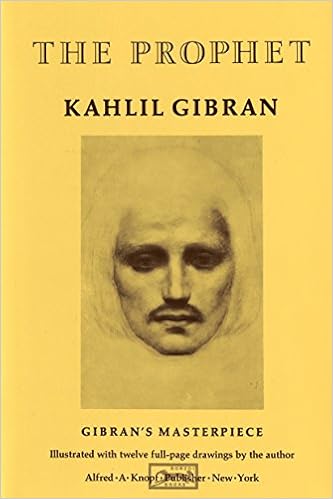
I started re-reading The Prophet recently, as I do every year or two. 
The Prophet by Kahlil Gibran
This book has brought me solace over the years. It is prose poetry, beautifully-written, that speaks to my soul. It is lovely, and it is mournful, and it reminds me to be more intentional, and every so often, something comes out and hits me over the head in an unexpected way:
"You have been told that, even like a chain,
you are as weak as your weakest link.
This is but half the truth. You are also as strong as your strongest link.
To measure you by your smallest deed is to reckon the power of ocean by the frailty of its foam.
To judge you by your failures is to cast blame upon the seasons for their inconstancy" (Gibran 86).
I've had so many people telling me that I am so strong going through all of this. That they don't know if they would be able to go through what I am going through. The thing is, I don't feel strong. It is not strength, but rather sheer force of will, stubbornness and spite, and just a touch of rage that has gotten me through this. A wise person once told me that you cannot pour from an empty cup, and there have been so many times that my cup has been so close to empty. I have succeeded in completing this step, no matter how close I've been to empty, and it is no small deed. Like the ocean, I will keep on keeping on, and like the seasons, I will be inconstant, but such is the measure of me.

I am strong, and I am weak.
"[T]here are those who have the truth within them, but they tell it not in words" (Gibran 60).

I will not ring the bell.


September 13, 2019

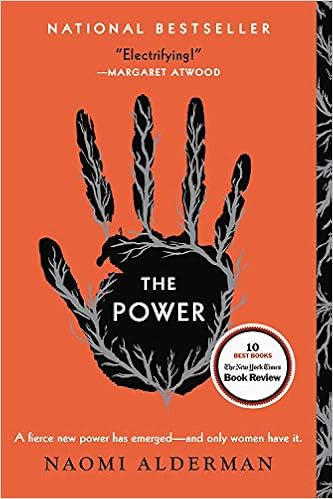
Did you read with me? The Power by Naomi Alderman

Did you Read with Me?


The Power
Because this is not like a traditional book club, I am posting this follow up because I finally finished the book. If you have not finished be aware, spoilers may be found in the rest of the post and in the comments. Continue if you dare!
Spoilers!
Before we start with any of the discussion questions that I had linked to before, I wanted to talk about a couple of things that stood out to me.

Remember, Amazon's blurb says
"In THE POWER, the world is a recognizable place: there's a rich Nigerian boy who lounges around the family pool; a foster kid whose religious parents hide their true nature; an ambitious American politician; a tough London girl from a tricky family. But then a vital new force takes root and flourishes, causing their lives to converge with devastating effect. Teenage girls now have immense physical power--they can cause agonizing pain and even death. And, with this small twist of nature, the world drastically resets."
I expected this book to play with gender roles in unexpected ways. I did not expect this book to completely avoid the idea of sex vs. gender in the way that it did. There was one male character who had the power (in one of Margot's chapters, because it was a boy that Jos knew) but the book made it clear the reason the boy had the power was because of a chromosomal abnormality. I expected Jos's troubles to turn out to be because she was trans, but unless I missed something, from what I can tell, the power was entirely determined by sex, not by gender. So she was just defective.

I was disappointed that there was this missed opportunity to examine how the power would affect those who are trans, those who are intersex, those who may have transitioned, and how the new society would affect, accept, or reject those who did not fit these norms. Besides the one boy (can anyone remind me of what chapter he appeared in??) the only examination of gender roles besides the obvious was with Jos and her trouble controlling her power. Her lack of control was presented as a defect, and I was not comfortable with the idea of her lack of control being viewed as failing to present her femininity in the expected and most appropriate way. In this book, are woman with the power expected to remain consistently in control? As a logical counter-example, are men in the real world (not the book) expected to remain consistently in control?

A couple of things that stood out to me before I address some of those discussion questions:

At one point, Tunde writes in his notes that
"At first we did not speak our hurt because it was not manly. Now we do not speak it because we are afraid and ashamed and alone without hope, each of us alone. It is hard to know when the first became the second" (Alderman 269). 
This really jumped out at me, not because of the evaluation of masculinity, but rather because of the universality of trauma. It is so easy to feel alone in whatever trauma you have experienced, and that feeling of aloneness leads to a stigma, a feeling of shame because how are we strong and independent people supposed to admit weakness as a result of our traumas? We all have traumas, right?

I have at least two separate moments in my life that definitively caused PTSD. I talk about those moments with close friends and family. I talk about those moments even more with my therapist. How many people talk about those moments at all? How many people suffer alone in their hurt?

Roxy and Tunde eventually end up together, and the next thing that really jumped out at me was:
"Their bodies have been rewritten by suffering" (Alderman 324).
This really speaks to me about identity. Suffering changes us fundamentally, mentally, emotionally, spiritually, even physically. Depending upon the kind of suffering we are talking about, there is a visceral change from deep within, and learning who you now are can be quite the journey. Of course, because of my diagnosis, there are certain things I pick up on. I have changed fundamentally because of this diagnosis. But the idea that the change is a rewriting of myself speaks to me as an English Instructor. Those of us who teach composition spend so much time talking about re-writing, the difference between revision versus proofreading, the importance of understanding that writing is a process.

Reading this, I suddenly had this feeling. Suffering changes us, but it had never before occurred to me that suffering could make us better. The other day, I was speaking with my therapist (remember, therapy is good, y'all!) and she said something that really changed my perspective. She told me that an oncologist had asked her why she decided she wanted to specialize in oncology counseling as opposed to all the other kinds that are out there. She told me that she thought about it, and told the doctor that she found that her patients discovered their best selves as they worked through treatments, pills, radiation, therapy, and everything else. She said that in other specialties, she rarely saw so much change so significantly in her other clients as in her oncology clients.

I think that my body has been rewritten by suffering. The beautiful part of that is that I get to rediscover who I am going to become.

So, in the meantime, let's talk discussion questions:
1. The premise of The Power seems to be that if a new world order were created—with women in charge—it would look little different from the way it does now. That woman would use their power to oppress men. Do you agree with that premise? Does Naomi Alderman make her case convincingly? Do you see other possibilities?

2. Follow-up to Question 1: The book poses a question: why do people abuse power? What does the book suggest the answer is? What is your answer?

3. As an interesting exercise, go through the novel to identify those societal structures, both legitimate and criminal, that have been changed by feminine power. Look at how the book treats religion, the military, sex trafficking and porn, harassment, even bullying. What does the new power inversion say about the way gender and sexuality operates in "normal" society (i.e., today in the early 21st century)?

4. In what ways does each of the four characters—Eve, Roxy, Tunde, and Margot—illuminate the events of the novel and all that has changed? Whose perspective or story do you find most interesting … or revealing … or engaging?

5. What do you make of Neil Adam Armon and his gushing letter to Naomi Alderman, "I am so grateful you could spare the time," and "Sorry, I'll shut up now"? If you are a woman, does that tone, do those words, have a familiar ring? Also, what's the joke here about appropriation, given that Alderman's name, not Neil's, ends up on the novel? (If you haven't already, play around with the letters of Neil's name.)

6. Vogue reviewer, Bridget Read (really), calls parts of the book "revenge porn." Do you agree with her label? Do you find the revenge satisfying or twisted … or both?

7. Neil ponders: "Gender is a shell game. What is a man? Whatever a woman isn't. What is a woman? Whatever a man is not. Tap on it and it's hollow. Look under the shells: It's not there." What does Neil mean, and do you agree or disagree? How do you see gender? Is it "real" or a social construct?

I will answer some (but not all) of the questions in the comments below.

Remember, spoilers abound!

August 19, 2019

First day of school!

Typically, on a day like today, I would be meeting anywhere from 30 to 80 new students on this the first day of school. The students don't seem to notice it, but usually I am as nervous for the first day as they are. I would talk about my classroom policies. I would show them their textbooks and explain how to get them. I would let them introduce themselves to each other, and to me. I would hide the first day of school jitters, and get right into the swing of things. By the end of the day, I probably would have forgotten most of the names of my new students, but I would work hard to get those names to stick in my head.
Today, I had no students to meet. No classes to teach. No textbooks to show, and no introductions to make.
Today, I ate, I napped, I cooked. I did my treatment, and then I napped some more. Today, more than any other day, I felt my diagnosis and it hurt me. I love to teach, and it is so hard to deal with losing my identity as an English Instructor, even if just for now. I miss the students that I won't get to meet. The awkward ones who will take weeks to open up to me, and the extroverted ones who will want to be BFFs right away. The high school dual enrollment students who don't quite know how to be college students, the freshman students who don't want to let go of high school, and the grown students who just want to get through this even as they work, raise their kids, pay their mortgage, get a divorce.
This is one of the hardest parts of my diagnosis. I've become so accustomed to having my life structured around the semester schedule. To paying attention to which classes are taught on which days. To studying up, because the craziest part of teaching is preparing yourself for the off-the-wall questions and oddball non sequiturs that students inevitably come up with. To planning my office hours and squeezing in the grading, reading, and advising. To updating PowerPoints, coming up with collaborative projects and thinking of other active learning activities.
Instead, I am finding other ways to structure my days. It's not the same as the structure of teaching, but for now, it will have to do.
To all of my co-workers and colleagues, I hope this first day of school went as smoothly and with the least amount of chaos as possible.
Happy first day of school!