Showing posts with label fave quote. Show all posts

May 19, 2020

Fave Quote of the Book: Small Victories by Anne Lamott (Part 2)

From Amazon:

So, where did we leave off? (LINK)

Was I saying that I came from an unhappy family?

What does it mean to have a happy family?

Who knew that I'd be exploring such difficult questions in a silly little blog that is supposed to be about non-cancer. Yet, here we are.

My family is special. I remember a childhood of laughter, silliness, bad jokes, talking lobsters, and spontaneous trips to unexpected locales.

I also remember a childhood with tears, fear, hurt and misunderstanding, and being misunderstood. As a shy introvert from an exceptionally loud family of extroverts, I spent too much time with my own thoughts, wishing I fit in better. I had feelings I didn't understand, couldn't put words to, and as an early reader who read "at the college level" by the time I was 11, it was unusual to be unable to find the words I needed.

We fought (and still fight). We cried (and still cry). We try to understand each other, even though it often feels like we all came from different planets. Are all families like that? I honestly don't know.

We had love, but we also had an unfair share of unhappiness. Well, I call it unfair, but I don't know if that is true either.

We have hard conversations, hard feelings, and hard hearts, and all the wishing in the world can't undo some of the terrible things we've done, or unsay the terrible things we've said. Lamott says,
"Forgiving people doesn’t necessarily mean you want to meet them for lunch. It means you try to undo the Velcro hook. Lewis Smedes said it best: “To forgive is to set a prisoner free and discover that the prisoner was you.” (Lamott 117).
As family, we should always be prepared to forgive, because we are family, right? Even the Bible says we should turn the other cheek, so forgiveness is the word of the day, yes?

Maybe.

For me, explicit forgiveness is not free. Again we come back to the idea of grace. I am not full of grace, I might be full of something, but grace ain't it. Forgiveness comes at the cost of acknowledging the wrong, committing to never repeat it, and apologizing. An apology involves the words "I am sorry" or "I apologize for the hurt I caused to you."

A non-pology might include the words "I'm sorry if..." or "I'm sorry but..."

"I'm sorry if I hurt your feelings" is NOT an apology. "I'm sorry but I didn't mean it that way" is NOT an apology. I'm sorry for anything that I might have done" is not an apology. It is so difficult to find grace when trust is broken. Trust might be healed if the apology includes a commitment to not repeat the transgression. Trust might be healed if the transgressor takes some action toward healing. Trust might be healed by respecting boundaries.

I am no expert on grace, but I have so many expectations. I love the idea of grace, of love undeserved and without conditions. I want to learn that grace.

My therapist tried to teach me about giving myself grace. Do you want to know what is even harder? Giving grace to others. But as Smedes above said, forgiveness sets us free. Perhaps that is the grace that I am looking for. That doesn't mean that my heart is left open to be trampled by any and all who wish to stomp on it. The doesn't mean that I have no hurts left, because I do. But in my quest for giving myself grace, I have to try to let go of those hurts and move forward. Unconditional love is not the same as unconditional trust, but maybe we can learn to get closer to that, no matter how far away that grace might seem.

Read this book. It is by far one of the best I've stumbled across in a while.

March 27, 2020

Fave Quote of the Book: Slaughterhouse-Five

Slaughterhouse-Five by Kurt Vonnegut


Amazon describes it like this:
Slaughterhouse-Five, an American classic, is one of the world’s great antiwar books. Centering on the infamous firebombing of Dresden, Billy Pilgrim’s odyssey through time reflects the mythic journey of our own fractured lives as we search for meaning in what we fear most.

One of my favorite bits:
The narrator reads a book by a doctor who write horror novels. In that book, the narrator reads, "No art is possible without a dance with death" (Vonnegut 21).

I am no doctor, and I am too much of a scaredy-cat to write or read horror novels, but this one sentence really spoke to me. Seeing as how I have cancer, and have had three brain surgeries in the last nine months, I'd argue that I've danced with death, at least a little, here and there. I'd also argue that some of my best writing has come about after my diagnosis, if I may be so bold as to toot my own horn here.

My diagnosis has made me even more cognizant of my own mortality, but beyond that, I've realized that I have so much left to say. The words pile up inside of me, as I write this blog, letters and cards to my loved ones (SNAIL MAIL!), in my own journal, the book that I'm writing. I have so many words, and even when I'm exhausted from the terrible insomnia, and even when I'm goldfishing, I've stories and poems and memories to share. I write and I write, and eventually, I sleep, and I read, and I write. If for nothing else, this has been a blessing for inspiring me to put ass to chair and hands on the keyboard, and I write and I write.

So it goes.

March 21, 2020

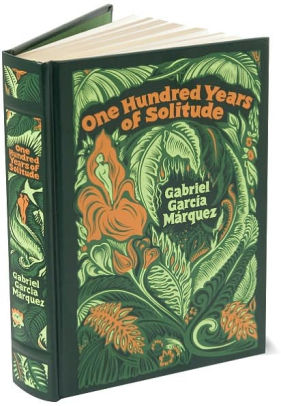
Fave Quote of the Book: One Hundred Years of Solitude by Gabriel Garcia Marquez

One Hundred Years of Solitude by Gabriel Garcia Marquez
Amazon link:
One of the twentieth century's enduring works, One Hundred Years of Solitude is a widely beloved and acclaimed novel known throughout the world and the ultimate achievement in a Nobel Prize-winning career.

The novel tells the story of the rise and fall of the mythical town of Macondo through the history of the Buendía family. Rich and brilliant, it is a chronicle of life, death, and the tragicomedy of humankind. In the beautiful, ridiculous, and tawdry story of the Buendía family, one sees all of humanity, just as in the history, myths, growth, and decay of Macondo, one sees all of Latin America.

Love and lust, war and revolution, riches and poverty, youth and senility, the variety of life, the endlessness of death, the search for peace and truth -- these universal themes dominate the novel. Alternately reverential and comical, One Hundred Years of Solitude weaves the political, personal, and spiritual to bring a new consciousness to storytelling. Translated into dozens of languages, this stunning work is no less than an account of the history of the human race.
I've read this book before, and only recently finished it. I don't know if I struggled with it because my brains have been poked and prodded, or because my memory sucks, or because this is just a tough book, but it takes place over the course of a literal hundred years, and many of the characters have the same names across generations. Aureliano Buendía and the 17 (literally 17) other Aurelianos over the years made this book a challenge for me this time around, but even though I found it challenging, I loved it. Gabriel García Marquez is the king of magical realism, and he gives the reader no chance to figure out which way is up before someone inexplicably floats away, someone else goes blind and nobody notices, and for no discernible reason, it rains for more than four years.

The version I read was translated by Gregory Rabassa, and he did an incredible job of keeping the lyrical prose and the poetry embedded in the plot with chapters that enveloped me in beautiful words and sentences like a warm blanket.

My favorite quote from this book, when a group of men are traveling through a dense jungle:
"The men on the expedition felt overwhelmed by their most ancient memories in that paradise of dampness and silence, going back to before original sin . . . For a week, almost without speaking, they went ahead like sleepwalkers through a universe of grief" (Garcia Marquez 11).
A universe of grief. My God, how beautiful is that?

I imagine the all-encompassing silence in this dense jungle. I remember the days after my diagnosis. After the sobbing, after the hysterics, the panic and fear. The stillness in the house. I felt like I was silently drowning in my sorrow. Shattered to pieces, scattered all over the floor. Days merged into nights, and still I cried until I was all dried up inside.

The men in this chapter are overwhelmed by ancient memories, and I was overwhelmed with ancient traumas from my youth rising to the surface unexpectedly. Old hurts mixed with the new, perhaps as a reminder we are made of all the pieces of our pasts, whether we like it or not. They say that the present is a gift, but if I may be so crude, sometimes, it is a shitty gift, the kind where you paste on a fake smile and hope nobody notices the disappointment in your eyes.

This universe of grief still overwhelms me. I mourn the many things I have lost, from the piece of bone in my skull to the ability to actively engage in large groups of people without debilitating anxiety. I grieve for all of these lost things, but none of that grief can be expressed as beautifully as GGM did. Read this book. It is beautiful and it is weird, and it is worth every page.

February 17, 2020

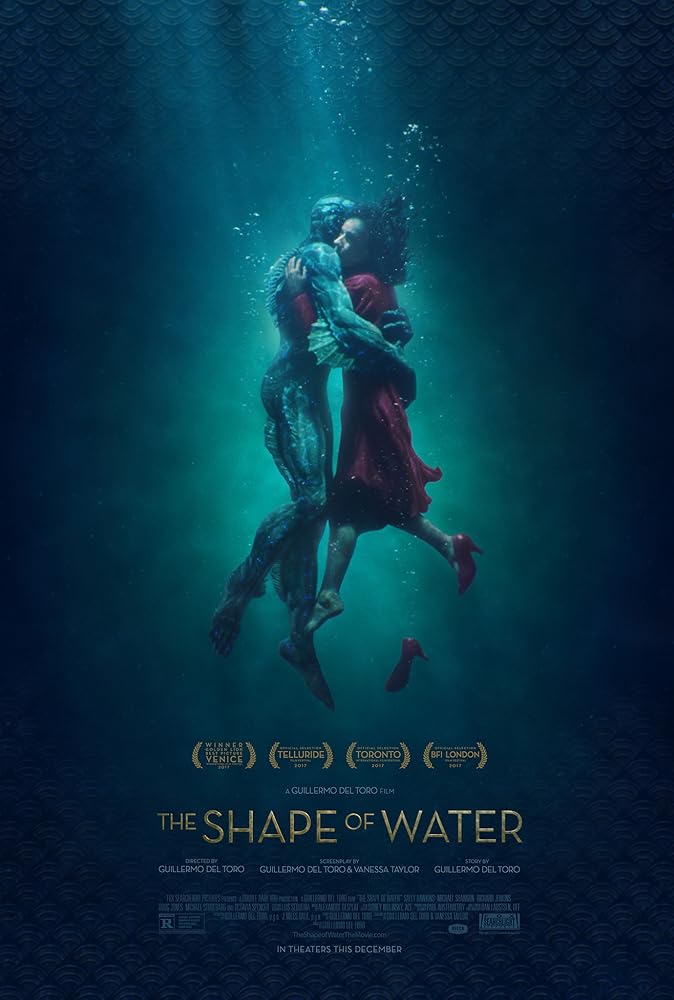
Fave Quote of the Movie: The Shape of Water directed by Guillermo del Toro

Now, I acknowledge that I am deviating from the original plan, which was to highlight my favorite quote of the book. But because I'm the boss of this blog, and because I just watched this awesome movie again recently, I decided I'm going to modify the plan. Instead of fave quote of the book, it will be fave quote of the whatever I just consumed: book, movie, poem, etc.

Without further ado, let's talk about The Shape of Water, directed by Guillermo del Toro.

IMDB link:
At a top secret research facility in the 1960s, a lonely janitor forms a unique relationship with an amphibious creature that is being held in captivity.
First, a warning: This movie is rated R; it contains both graphic sexuality and violence. If you choose to watch with your children (or parents, or any other family members) the sex scenes might make you feel extremely awkward. It also contains exactly the amount of racism, misogyny, and homophobia which you might expect from a movie taking place in the 1960s.

Even with all of that being said, this movie is visually stunning. There is so much to unpack about this story, but before I get into all of that, I want to tell you my favorite quote from this movie:
"Unable to perceive the shape of you,
I find you all around me.
Your presence fills my eyes with your love.
It humbles my heart,
for you are everywhere."
I had to look up this poem; I needed to know more about it. At first, it was possibly attributed to 13th century Sufi poet Rumi, but additional research found that "a translation by Priya Hemenway on page 41 of The Book of Everything (first line: “Unable to discern the form of You, / I see your Your presence all around.”) is actually much closer in wording to the text of the poem at the end of the movie" (Armenti).

This sourcing seems to take this poem not necessarily as a poem of romantic love and loss, but one of faith. It is talking about God, about Allah. I acknowledge that even taking this direction may be off-putting for some, but I hope that we can all agree, regardless of whom or what we believe in, there is a nearly universal understanding that we should be kind, we should be loving, we should, as much as we can, avoid being jerks.

So, then, what is the shape of water? It is life-giving, ever-changing, so powerful. It is everywhere. It can flow and it can crash.  The shape of water is a paradox. Quenching our thirst, filling our eyes and our lungs.  How can we rightfully describe something whose form cannot be discerned? Is that faith? Is it love? Does it truly surround us? Are there answers to these questions?

This sci-fi/fantasy movie is lovely. It washes over me like ocean waves. I feel compassion and disgust, I feel comfort and imbalance. I feel water all around me.


Remember Bruce Lee: Be water, my friends.