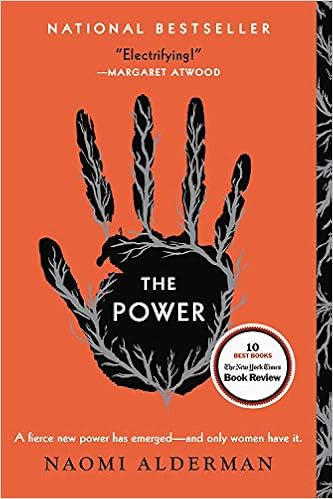
Did you
Read with Me?
Because this is not like a traditional book club, I am posting this follow up because I finally finished the book. If you have not finished be aware, spoilers may be found in the rest of the post and in the comments. Continue if you dare!
 |
| Spoilers! |
Before we start with any of the
discussion questions
that I had linked to before, I wanted to talk about a couple of things that stood out to me.
Remember, Amazon's blurb says
"In THE POWER, the world is a recognizable place: there's a rich Nigerian
boy who lounges around the family pool; a foster kid whose religious
parents hide their true nature; an ambitious American politician; a
tough London girl from a tricky family. But then a vital new force takes
root and flourishes, causing their lives to converge with devastating
effect. Teenage girls now have immense physical power--they can cause
agonizing pain and even death. And, with this small twist of nature, the
world drastically resets."
I expected this book to play with gender roles in unexpected ways. I did not expect this book to completely avoid the idea of sex vs. gender in the way that it did. There was one male character who had the power (in one of Margot's chapters, because it was a boy that Jos knew) but the book made it clear the reason the boy had the power was because of a chromosomal abnormality. I expected Jos's troubles to turn out to be because she was trans, but unless I missed something, from what I can tell, the power was entirely determined by sex, not by gender. So she was just defective.
I was disappointed that there was this missed opportunity to examine how the power would affect those who are trans, those who are intersex, those who may have transitioned, and how the new society would affect, accept, or reject those who did not fit these norms. Besides the one boy (can anyone remind me of what chapter he appeared in??) the only examination of gender roles besides the obvious was with Jos and her trouble controlling her power. Her lack of control was presented as a defect, and I was not comfortable with the idea of her lack of control being viewed as failing to present her femininity in the expected and most appropriate way. In this book, are woman with the power expected to remain consistently in control? As a logical counter-example, are men in the real world (not the book) expected to remain consistently in control?
A couple of things that stood out to me before I address some of those
discussion questions:
At one point, Tunde writes in his notes that
"At first we did not speak our hurt because it was not manly. Now we do not speak it because we are afraid and ashamed and alone without hope, each of us alone. It is hard to know when the first became the second" (Alderman 269).
This really jumped out at me, not because of the evaluation of masculinity, but rather because of the universality of trauma. It is so easy to feel alone in whatever trauma you have experienced, and that feeling of aloneness leads to a stigma, a feeling of shame because how are we strong and independent people supposed to admit weakness as a result of our traumas? We all have traumas, right?
I have at least two separate moments in my life that definitively caused PTSD. I talk about those moments with close friends and family. I talk about those moments even more with my therapist. How many people talk about those moments at all? How many people suffer alone in their hurt?
Roxy and Tunde eventually end up together, and the next thing that really jumped out at me was:
"Their bodies have been rewritten by suffering" (Alderman 324).
This really speaks to me about identity. Suffering changes us fundamentally, mentally, emotionally, spiritually, even physically. Depending upon the kind of suffering we are talking about, there is a visceral change from deep within, and learning who you now are can be quite the journey. Of course, because of my diagnosis, there are certain things I pick up on. I have changed fundamentally because of this diagnosis. But the idea that the change is a rewriting of my
self speaks to me as an English Instructor. Those of us who teach composition spend so much time talking about re-writing, the difference between revision versus proofreading, the importance of understanding that writing is a process.
Reading this, I suddenly had this feeling. Suffering changes us, but it had never before occurred to me that suffering could make us
better. The other day, I was speaking with my therapist (remember, therapy is good, y'all!) and she said something that really changed my perspective. She told me that an oncologist had asked her why she decided she wanted to specialize in oncology counseling as opposed to all the other kinds that are out there. She told me that she thought about it, and told the doctor that she found that her patients discovered their best selves as they worked through treatments, pills, radiation, therapy, and everything else. She said that in other specialties, she rarely saw so much change so significantly in her other clients as in her oncology clients.
I think that my body has been rewritten by suffering. The beautiful part of that is that I get to rediscover who I am going to become.
So, in the meantime, let's talk
discussion questions:
1. The premise of The Power seems to be that if a new world
order were created—with women in charge—it would look little different
from the way it does now. That woman would use their power to oppress
men. Do you agree with that premise? Does Naomi Alderman make her case
convincingly? Do you see other possibilities?
2. Follow-up to Question 1: The book poses a question: why do people abuse power? What does the book suggest the answer is? What is your answer?
3.
As an interesting exercise, go through the novel to identify those
societal structures, both legitimate and criminal, that have been
changed by feminine power. Look at how the book treats religion, the
military, sex trafficking and porn, harassment, even bullying. What does
the new power inversion say about the way gender and sexuality operates
in "normal" society (i.e., today in the early 21st century)?
4.
In what ways does each of the four characters—Eve, Roxy, Tunde, and
Margot—illuminate the events of the novel and all that has changed?
Whose perspective or story do you find most interesting … or revealing …
or engaging?
5. What do you make of Neil Adam Armon and his
gushing letter to Naomi Alderman, "I am so grateful you could spare the
time," and "Sorry, I'll shut up now"? If you are a woman, does that
tone, do those words, have a familiar ring? Also, what's the joke here
about appropriation, given that Alderman's name, not Neil's, ends up on
the novel? (If you haven't already, play around with the letters of
Neil's name.)
6. Vogue reviewer, Bridget Read (really),
calls parts of the book "revenge porn." Do you agree with her label? Do
you find the revenge satisfying or twisted … or both?
7. Neil
ponders: "Gender is a shell game. What is a man? Whatever a woman isn't.
What is a woman? Whatever a man is not. Tap on it and it's hollow. Look
under the shells: It's not there." What does Neil mean, and do you
agree or disagree? How do you see gender? Is it "real" or a social
construct?
I will answer some (but not all) of the questions in the comments below.
Remember, spoilers abound!